The Galician Coastal Observatory is replacing the Muros buoy with a more advanced model to enhance real-time marine monitoring in the Galician estuaries
- The new buoy will facilitate maintenance work and allow the incorporation of new sensors to expand environmental monitoring capabilities
- The station is part of the automatic network of the Xunta’s (Galician Regional Government) Coastal Observatory, which provides real-time oceanographic and meteorological data
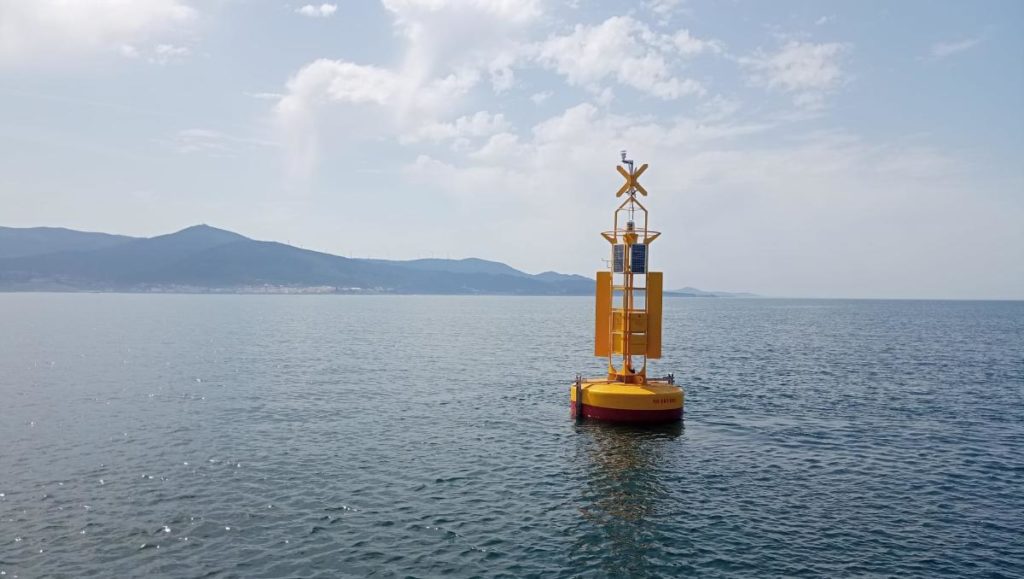
The Xunta’s Coastal Observatory has replaced the Muros oceanographic buoy with a new, larger one offering improved technical performance, to enhance real-time marine observation capabilities in the Galician estuaries.
The new platform will improve the station’s operational and maintenance conditions, as well as facilitate the installation of new sensors, thereby expanding environmental monitoring capabilities in an area of significant interest to the maritime and fishing sectors and for studying the effects of climate change on coastal ecosystems.
This station forms part of the network of automatic platforms maintained by the Centro Tecnolóxico do Mar-Fundación CETMAR within the framework of the Galician Coastal Observatory (OCXG). This is a public marine observation and forecasting infrastructure that integrates real-time monitoring capabilities, numerical modelling and operational services geared towards coastal management and the maritime sectors. The buoy transmits data every ten minutes, including water temperature, salinity, currents and weather conditions. This information is freely available via the Observatory’s platform website.
The Observatory is based on collaboration between three regional government bodies: representing the Regional Ministry of the Sea, the Technological Institute for the Control of the Marine Environment of Galicia (Intecmar) and the CETMAR Foundation; and on behalf of the Regional Ministry of the Environment and Climate Change, through Meteogalicia. This cooperation enables the integration of observation, forecasting and operational services into a single coordinated system serving society and Galicia’s blue economy.
The OCXG comprises various infrastructures and measurement systems distributed along the Galician coast, including oceanographic buoys, fixed platforms, coastal weather stations, high-frequency radars (HF Radar) and environmental monitoring systems on shellfish beds and mussel rafts. All these systems provide essential information for monitoring their condition.
In addition to monitoring, the Observatory works with advanced forecasting tools based on numerical models developed and run daily by Meteogalicia, as well as the operational support provided by Intecmar to the CAMGAL Plan for fighting accidental marine pollution. These systems enable the generation of oceanographic and meteorological forecasts, used by public authorities, industry, and emergency services.
IDISOM
The Coastal Observatory, co-funded by the Xunta and the European Union through the European Maritime, Fisheries and Aquaculture Fund (EMFAF), is also working towards integration into IDISOM, the national Distributed Marine Observation Infrastructure, to strengthen scientific and technical coordination between the national ocean observation infrastructures.
The incorporation of the OCGX would contribute Galician expertise in operational coastal oceanography, as well as its capabilities in real-time observation, modelling and end-user-oriented services. Similarly, it would facilitate the interoperability of data and services at a national level, reinforcing Galicia’s position as a benchmark in the field of marine observation. It allows the development of an integrated marine monitoring network serving research, public management and the productive sectors.
The replacement of the Muros buoy is included in the Xunta’s commitment to consolidating and modernising Galicia’s marine observation infrastructure, strengthening the response to the challenges associated with climate change and contributing to the protection and sustainable management of the marine environment.